Thursday, August 13, 2015

Selling your home

In today’s market, where demand is outpacing supply in many regions of the country, pricing a house is one of the biggest challenges real estate professionals face. Sellers often want to price their home higher than recommended, and many agents go along with the idea to keep their clients happy.

However, the best agents realize that telling the homeowner the truth is more important than getting the seller to like them.

There is no “later.”

Sellers sometimes think, “If the home doesn’t sell for this price, I can always lower it later.” However, research proves that homes that experience a listing price reduction sit on the market longer, ultimately selling for less than similar homes.

John Knight, recipient of the University Distinguished Faculty Award from the Eberhardt School of Business at the University of the Pacific, actually did research on the cost (in both time and money) to a seller who priced high at the beginning and then lowered the their price. In his article, Listing Price, Time on Market and Ultimate Selling Price published in Real Estate Economics revealed:
“Homes that underwent a price revision sold for less, and the greater the revision, the lower the selling price. Also, the longer the home remains on the market, the lower its ultimate selling price.”
Additionally, the “I’ll lower the price later” approach can paint a negative image in buyers’ minds. Each time a price reduction occurs, buyers can naturally think, “Something must be wrong with that house.” Then when a buyer does make an offer, they low-ball the price because they see the seller as “highly motivated.” Pricing it right from the start eliminates these challenges.

Don’t build “negotiation room” into the price.

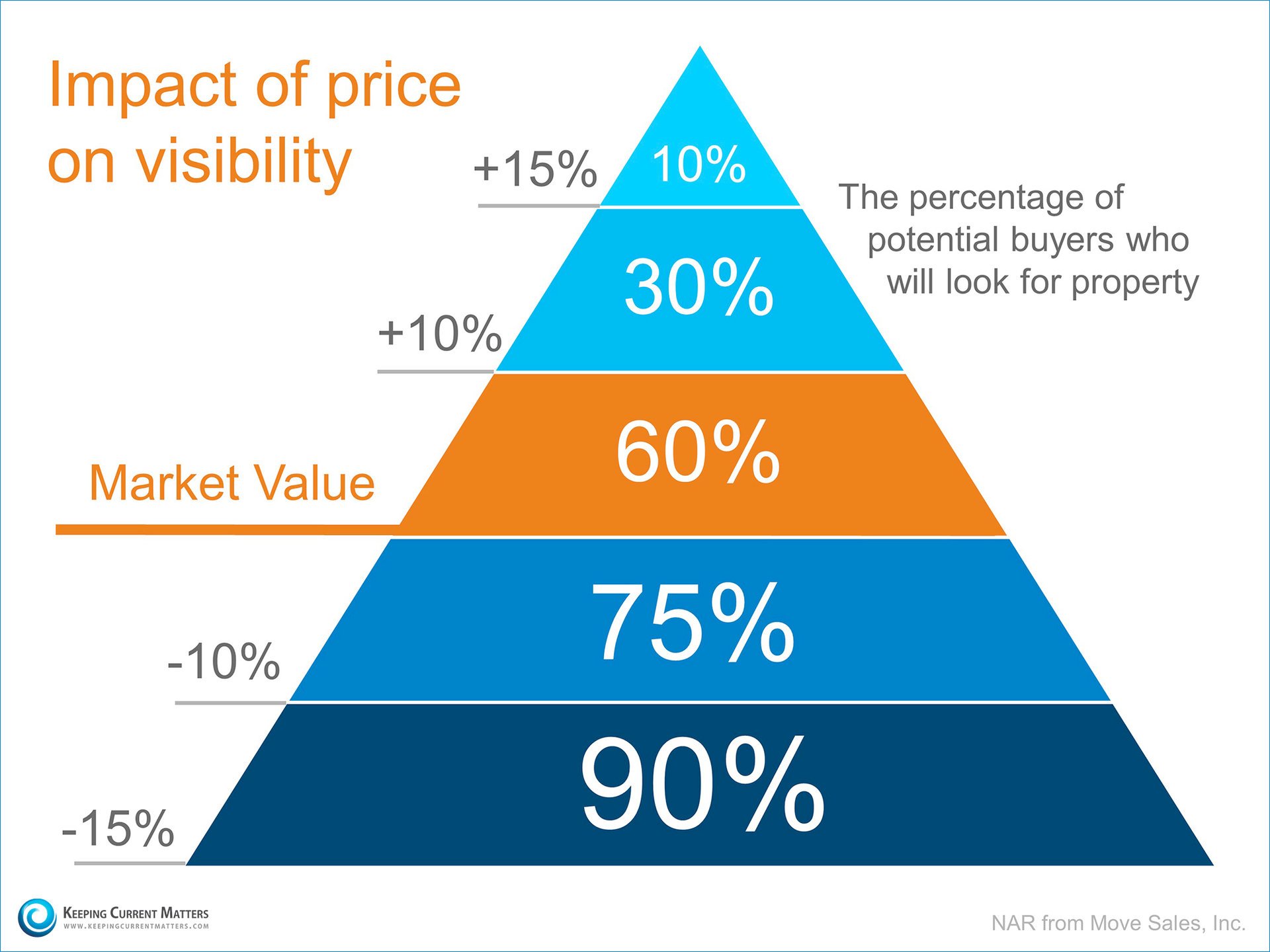
Many sellers say that they want to price their home high in order to have “negotiation room.” But, what this actually does is lower the number of potential buyers that see the house. And we know that limiting demand like this will negatively impact the sales price of the house.

Not sure about this? Think of it this way: when a buyer is looking for a home online (as they are doing more and more often), they put in their desired price range. If your seller is looking to sell their house for $400,000, but lists it at $425,000 to build in “negotiation room,” any potential buyers that search in the $350k-$400k range won’t even know your listing is available, let alone come see it!
One great way to see this is with the chart below. The higher you price your home over its market value, the less potential buyers will actually see your home when searching.
Price & Visibility | Keeping Current Matters

A better strategy would be to price it properly from the beginning and bring in multiple offers. This forces these buyers to compete against each other for the “right” to purchase your house.

Look at it this way: if you only receive one offer, you are set up in an adversarial position against the prospective buyer. If, however, you have multiple offers, you have two or more buyers fighting to please you. Which will result in a better selling situation?

The Price is Right

Great pricing comes down to truly understanding the real estate dynamics in your neighborhood.

Look for an agent that will take the time to simply and effectively explain what is happening in the housing market and how it applies to your home.

You need an agent that will tell you what you need to know rather than what you want to hear. This will put you in the best possible position.

Friday, July 31, 2015

Home Prices are Rising

Inventory Levels & Demand

Sales of existing homes rose 3.2% from May, outpacing year-over-year figures for the ninth consecutive month. Total unsold housing inventory is at a 5.0-month supply.

This is down from May’s 5.1-month supply and remains below the 6 months that is needed for a historically normal market.

Consumer confidence is at the highest level in over a decade. Pair that with interest rates still around 4%, new programs available for down payments as low as 3%, and you have an attractive market for buyers.

Buyer demand for housing surged to it’s highest level since June 2013.

Prices Rising

June marked the 40th consecutive month of year-over-year price gains as the median price of existing homes sold rose to $236,400 (up 6.5% from 2014).

So What Does This Mean?

The chart below shows the impact that inventory levels have on home prices.

The Impact of Inventory on Home Prices | Simplifying The Market

NAR’s Chief Economist, Lawrence Yun gave some insight into the correlation:
"Limited inventory amidst strong demand continues to push home prices higher, leading to declining affordability for prospective buyers."
NAR’s President, Chris Polychron added:
"The demand for buying has really heated up this summer, leading to multiple bidders and homes selling at or above asking price."

Bottom Line

If you are debating putting your home on the market in 2015, now may be the time. The number of buyers ready and willing to make a purchase is at the highest level in years. Let's get together to discuss your options.

For Sale By Owner Or Not? 5 Reasons You Shouldn’t

In today's market, with homes selling quickly and prices rising some homeowners might consider trying to sell their home on their own, known in the industry as a For Sale by Owner (FSBO). There are several reasons this might not be a good idea for the vast majority of sellers.

Here are five reasons:

1. There Are Too Many People to Negotiate With

Here is a list of some of the people with whom you must be prepared to negotiate if you decide to For Sale By Owner:
  • The buyer who wants the best deal possible
  • The buyer’s agent who solely represents the best interest of the buyer
  • The buyer’s attorney (in some parts of the country)
  • The home inspection companies which work for the buyer and will almost always find some problems with the house.
  • The appraiser if there is a question of value

2. Exposure to Prospective Purchasers

Recent studies have shown that 88% of buyers search online for a home. That is in comparison to only 21% looking at print newspaper ads. Most real estate agents have an internet strategy to promote the sale of your home. Do you?

3. Results Come from the Internet

Where do buyers find the home they actually purchased?
  • 43% on the internet
  • 9% from a yard sign
  • 1% from newspaper
The days of selling your house by just putting up a sign and putting it in the paper are long gone. Having a strong internet strategy is crucial.

4. FSBOing has Become More and More Difficult

The paperwork involved in selling and buying a home has increased dramatically as industry disclosures and regulations have become mandatory. This is one of the reasons that the percentage of people FSBOing has dropped from 19% to 9% over the last 20+ years.

5. You Net More Money when Using an Agent

Many homeowners believe that they will save the real estate commission by selling on their own. Realize that the main reason buyers look at FSBOs is because they also believe they can save the real estate agent’s commission. The seller and buyer can’t both save the commission.

Studies show that the typical house sold by the homeowner sells for $208,000 while the typical house sold by an agent sells for $235,000. This doesn’t mean that an agent can get $27,000 more for your home as studies have shown that people are more likely to FSBO in markets with lower price points. However, it does show that selling on your own might not make sense.

Bottom Line

Before you decide to take on the challenges of selling your house on your own, sit with a real estate professional in your marketplace and see what they have to offer.

Thursday, July 30, 2015

Top 10 Cities for real estate

The cities ranking as the healthiest in 2015, according to WalletHub, are:
  1. Boston, Mass.
  2. Oklahoma City, Okla.
  3. San Antonio, Texas
  4. Northern New Jersey, N.J.
  5. Hartford, Conn.
  6. Austin, Texas
  7. New York City, N.Y.
  8. Rochester, N.Y.
  9. Philadelphia, Pa.-N.J.
  10. Houston, Texas

Rents will increase...they will

Landlords will almost always remember to increase your rent each year. Maybe it’s just a few percent, maybe it’s a few hundreds of dollars. Or you may be one of the lucky few not to see your rent jump. Whatever it is, enjoy it while it lasts — it’s only getting worse.

Rent increases are expected to get steeper with the rental vacancy rate hitting a 30-year low of 6.8% this quarter, the U.S. Census Bureau announced on Tuesday. That means about 93.2% of America’s rental housing units are rented out — a level of demand the nation hasn’t seen since 1985. As a result, economists predict rent increases are “set to accelerate” to about 5% this year and the next, marking one of the highest periods of rent growth on record, according to Bloomberg News.


The upside, however hard to see, is that it might be time to consider actually purchasing an apartment or house. That could also help lift up a flagging homeownership rate, a trend tied to all sorts of economic woes.

Learn more about FHA Loans

The Federal Housing Administration (FHA) is a government agency within the U.S. Department of Housing and Urban Development (HUD). FHA is not a lender. It provides an insurance fund that protects lenders against borrower fha loan defaults. Therefore, to obtain an FHA loan, a Miami homebuyer must get their loan through an FHA-approved lender. The actual loan and mortgage for your home is actually with a commercial lender.
Not all FHA-approved lenders offer the same interest rates and costs, even for the same loan. Therefore, borrowers need to shop around with multiple lenders for the best total package for an FHA loan.

Here’s some good news…
  • Perfect credit is not a requirement of FHA. The FHA does not dictate a minimum credit score. However, lenders can overlay their own requirements on top of what FHA requires. FHA provides leeway in underwriting for the lender by insuring the loan, but the final decision about the loan is in the lenders hands.
The lenders’ underwriting of a loan is targeted at ensuring that the homebuyer “has the willingness and capability to repay the loan, but we do have flexibility beyond pure credit score to look at the borrower’s financial situation,” according to Vicki Bott, HUD deputy assistant secretary.
  • The minimum down payment is 3.5% of the purchase price of the home. Borrowers can use their own savings for the down payment. But, they can also use other sources such as a gift from a family member.
  • Closing costs may also be covered. FHA allows home sellers, builders, and lenders to pay some of the borrower’s closing costs. However, lenders often charge a higher interest rate if they agree to pay closing costs.
Here are some cautions…
  • Homebuyers should get a Good Faith Estimate (GFE) of closing costs from the lender when shopping for their loan.
  • Mortgage Insurance is a must. Two premiums are required on all FHA loans: first, an upfront premium of 2.25%, charged when the homebuyer gets the loan (but may be financed in the loan); and second, an annual premium of 0.55% paid monthly with the mortgage payment.
Many homebuyers feel this all sounds expensive. However, the alternative is potentially not qualifying for a loan at all. The borrower must compare total costs of the purchase with the equity that potentially is possible in the long haul…along with careful shopping for the loan.

Wednesday, July 29, 2015

Why You Should Sell Now!

As the temperature rises, buyers are coming out ready to purchase their dream home. Inventory is still below historic numbers and demand is strong. Don’t miss out on this great opportunity for you and your family.

Here are five reasons to list your home now.

1. Demand is Strong

Foot traffic refers to the number of people out actually physically looking at homes right now. The latest foot traffic numbers show that there are more prospective purchasers currently looking at homes than at any other time in the last 12 months which includes last spring’s buyers’ market. These buyers are ready, willing and able to purchase… and are in the market right now!
Take advantage of the buyer activity currently in the market.

2. There Is Less Competition Now

Housing supply just dropped to 4.6 months, which is under the 6 months’ supply that is needed for a normal housing market. This means, in many areas, there are not enough homes for sale to satisfy the number of buyers in that market. This is good news for home prices. However, additional inventory is about to come to market.
There is a pent-up desire for many homeowners to move as they were unable to sell over the last few years because of a negative equity situation. Homeowners are now seeing a return to positive equity as real estate values have increased over the last two years. Many of these homes will be coming to the market in the near future.
Also, new construction of single-family homes is again beginning to increase. A study by Harris Poll revealed that 41% of buyers would prefer to buy a new home while only 21% prefer an existing home (38% had no preference).
The choices buyers have will continue to increase. Don’t wait until all this other inventory of homes comes to market before you sell.

3. The Process Will Be Quicker

One of the biggest challenges of the housing market in recent times has been the length of time it takes from contract to closing. Banks are requiring more and more paperwork before approving a mortgage. As the market heats up, banks will be inundated with loan inquiries causing closing timelines to lengthen. Selling now will make the process quicker & simpler.

4. There Will Never Be a Better Time to Move-Up

If you are moving up to a larger, more expensive home, consider doing it now. Prices are projected to appreciate by over 19.3% from now to 2019. If you are moving to a higher priced home, it will wind-up costing you more in raw dollars (both in down payment and mortgage payment) if you wait. You can also lock-in your 30-year housing expense with an interest rate under 4% right now. Rates are projected to increase by about three quarters of a percent by the end of 2015.

5. It’s Time to Move On with Your Life

Look at the reason you decided to sell in the first place and determine whether it is worth waiting. Is money more important than being with family? Is money more important than your health? Is money more important than having the freedom to go on with your life the way you think you should?
Only you know the answers to the questions above. You have the power to take back control of the situation by putting your home on the market. Perhaps, the time has come for you and your family to move on and start living the life you desire.

That is what is truly important.